
The Connection Between HVAC Maintenance and Your Cat’s Comfort
If you share your home with a cat, you already know that their well-being takes priority in almost every household decision.
You carefully select their food, monitor their health, and create cozy spaces for them to rest.
But there is one factor that many cat owners overlook entirely: the quality of the air inside your home. Your HVAC system, which stands for heating, ventilation, and air conditioning, does far more than regulate temperature.
It actively shapes the environment your cat breathes, sleeps, and plays in every single day.
Cats are sensitive creatures.
Their respiratory systems, immune responses, and even their stress levels can be affected by airborne particles, humidity levels, and temperature fluctuations.
When your HVAC system is well-maintained, it becomes a quiet protector of your cat’s health.
When it is neglected, it can become a source of invisible hazards that accumulate over time.
Understanding this connection can genuinely change how you approach home maintenance, and it starts with knowing exactly what your HVAC system does for the air your cat breathes.
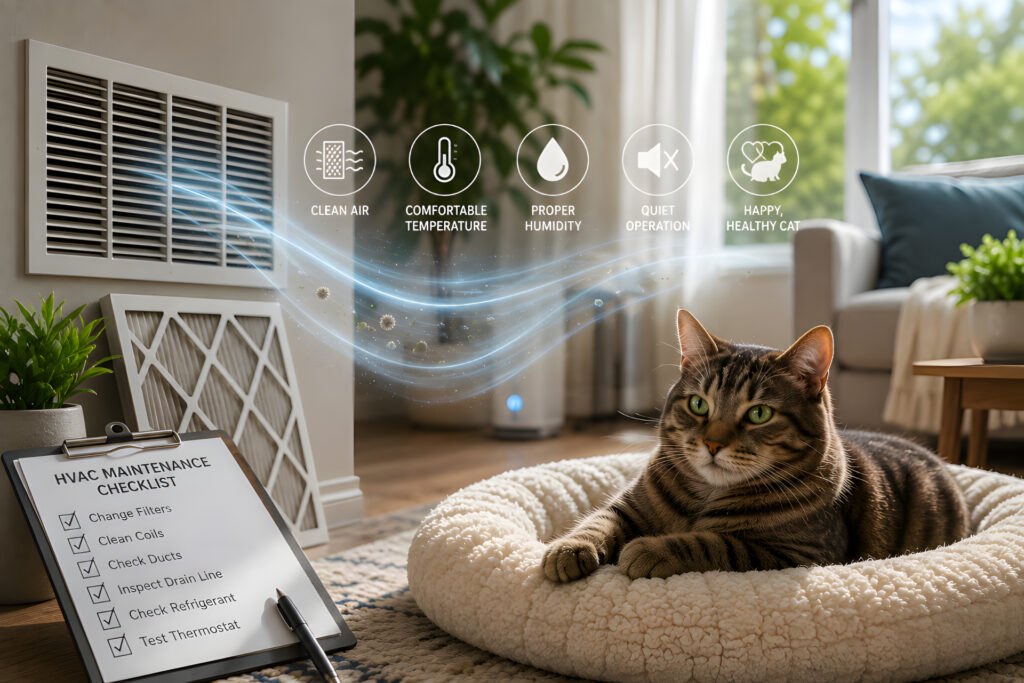
Connection Between HVAC Maintenance
How Air Quality Affects Your Cat’s Respiratory Health
Cats have highly efficient respiratory systems, but that efficiency also makes them more sensitive to airborne irritants. Dust mites, mold spores, pet dander from other animals, volatile organic compounds, and even microscopic debris from everyday household activities all circulate through your home’s air. When your HVAC system is dirty or poorly maintained, it does not filter these particles effectively. Instead, it recirculates them throughout your living space.
Common signs that air quality may be affecting your cat include persistent sneezing, watery or irritated eyes, coughing, lethargy, and in more serious cases, wheezing or labored breathing. Cats with pre-existing conditions such as feline asthma or chronic upper respiratory infections are especially vulnerable. For these animals, a dusty or contaminated air supply is not just uncomfortable; it can trigger real medical events.
Changing your HVAC filters regularly is one of the simplest and most impactful things you can do. Filters should typically be replaced every one to three months, depending on the filter type and how many pets live in the home. Homes with multiple cats may need more frequent changes due to the higher volume of dander and fur being pulled into the system. A high-efficiency particulate air filter, commonly known as a HEPA filter, captures significantly more fine particles than standard fiberglass filters, making it a worthwhile upgrade for pet households.
Beyond the filters themselves, the ductwork running through your home deserves serious attention. Ducts accumulate dust, debris, hair, and potentially mold over years of use. When the system runs, these contaminants are pushed directly into your living spaces. Working with trusted air duct cleaners periodically ensures that the pathways carrying air through your home are clean, clear, and free of the buildup that can compromise your cat’s respiratory health.
Temperature Regulation and Your Cat’s Physical Comfort
Cats are not just sensitive to what they breathe. They are also highly attuned to temperature. Despite their reputation for being low-maintenance, cats have real physiological needs when it comes to ambient warmth and coolness. Most domestic cats are comfortable in environments between 60 and 80 degrees Fahrenheit, though individual preferences vary depending on breed, age, and health status.
Kittens and senior cats are particularly vulnerable to temperature extremes. A kitten’s body cannot regulate heat as efficiently as an adult cat’s, and older cats often suffer from arthritis or weakened immune systems that make both cold drafts and excessive heat more difficult to tolerate. Breeds with flat faces, such as Persians and Himalayans, are also at heightened risk during warm weather because their shortened airways make cooling through panting far less effective.
A well-functioning HVAC system maintains consistent indoor temperatures without dramatic swings. When the system is struggling due to dirty coils, a clogged filter, or refrigerant issues, it tends to cycle more erratically. This leads to uneven temperatures throughout the home, rooms that feel significantly warmer or cooler than others, and periods where the system simply cannot keep up with outdoor conditions. For a cat resting in a sunroom or a bedroom at the end of a long duct run, this inconsistency can translate to genuine physical discomfort.
Routine HVAC maintenance, including cleaning the evaporator and condenser coils, checking refrigerant levels, and inspecting the thermostat calibration, helps the system run evenly and efficiently. This benefits your energy bills, of course, but it also means your cat experiences a more stable, comfortable environment throughout every season.
Humidity, Mold, and the Hidden Risks in Your Home
Humidity is another dimension of indoor air quality that directly affects your cat’s health, and it is one that many homeowners do not connect to their HVAC system at all. Your air conditioning unit does more than cool the air; it removes moisture from it. When the system is undersized, poorly maintained, or running inefficiently, it may fail to dehumidify adequately, especially during humid months.
High indoor humidity creates an environment where mold and mildew thrive. Mold spores are a serious respiratory irritant for cats, and chronic exposure can contribute to fungal infections in some cases. Beyond mold, overly humid air tends to harbor higher concentrations of dust mites, which are a common allergen for both cats and humans. Cats with allergies may develop skin conditions such as over-grooming, hair loss, or persistent itching when mold spores or dust mites are present in elevated quantities.
On the opposite end of the spectrum, very dry air, which can occur in winter when heating systems run continuously, causes its own set of problems. Low humidity dries out mucous membranes, making cats more susceptible to upper respiratory infections and making existing nasal issues worse. Dry air can also exacerbate skin irritation and increase the static charge in a cat’s fur, which many cats find genuinely distressing.
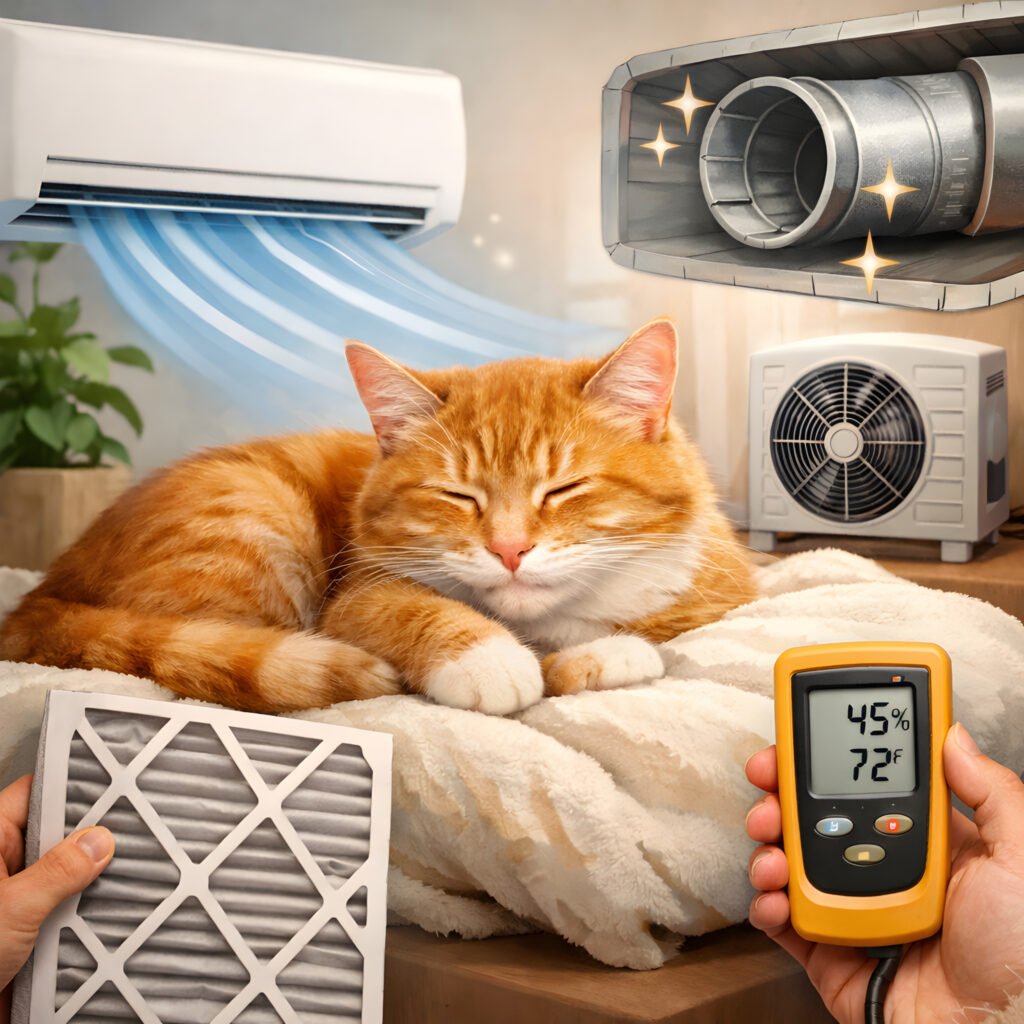
Maintaining indoor humidity between 40 and 60 percent creates a comfortable and healthy environment for cats and humans alike. Your HVAC system plays a central role in achieving this balance. Ensuring that drain pans and condensate lines are clean and free-flowing prevents moisture from backing up and creating localized humidity issues around the unit itself. In very dry climates or during harsh winters, a whole-home humidifier integrated with the HVAC system can help maintain appropriate moisture levels without requiring standalone units in every room.
Reducing Stress Through a Stable Home Environment
This connection is less obvious, but it matters enormously for cat owners. Cats are creatures of routine and predictability. Sudden changes in their environment, whether related to sound, temperature, or smell, can trigger anxiety, stress behaviors, and even health issues. A malfunctioning HVAC system can introduce all three of these stressors simultaneously.
Consider what happens when a heating or cooling unit begins to fail. It may produce unusual noises, from banging and rattling to high-pitched squealing. These sounds are alarming to cats, who have excellent hearing and are highly attuned to auditory changes in their environment. A system cycling on and off more frequently than normal creates a stop-start pattern of noise that disrupts a cat’s sense of calm. Even the smell of burning dust when a system first activates after a long period of inactivity can cause a cat to become anxious or avoidant in certain areas of the home.
Odors circulated through a dirty HVAC system deserve particular mention. Cats rely heavily on scent to interpret their world, and unpleasant or unfamiliar odors carried through the air can make certain rooms feel unsafe to them. A cat that begins avoiding a room it previously enjoyed may simply be responding to a smell that humans cannot easily detect.
Regular HVAC maintenance reduces unexpected malfunctions, keeps the system running quietly and smoothly, and prevents the circulation of stale or odor-laden air. For sensitive or anxious cats, this consistency is not a small thing. It is a genuine contribution to their daily sense of security and comfort.
Conclusion
Your cat’s health and happiness are influenced by more factors than food and veterinary care. The air they breathe, the temperatures they rest in, the humidity levels surrounding them, and the sounds they hear all shape their daily experience. Your HVAC system sits at the center of all of these variables, quietly either supporting or undermining your pet’s well-being with every cycle it runs.
The good news is that maintaining your HVAC system is not complicated, and the benefits extend well beyond your cat. Cleaner air, more stable temperatures, appropriate humidity, and a quieter home are things every member of your household will appreciate.
Start with the basics: replace filters regularly, schedule a professional HVAC inspection once or twice a year, and have your ductwork evaluated if it has been several years since the last cleaning. Pay attention to any changes in your cat’s breathing, skin condition, or behavior, and consider whether your home’s air quality may be a contributing factor.